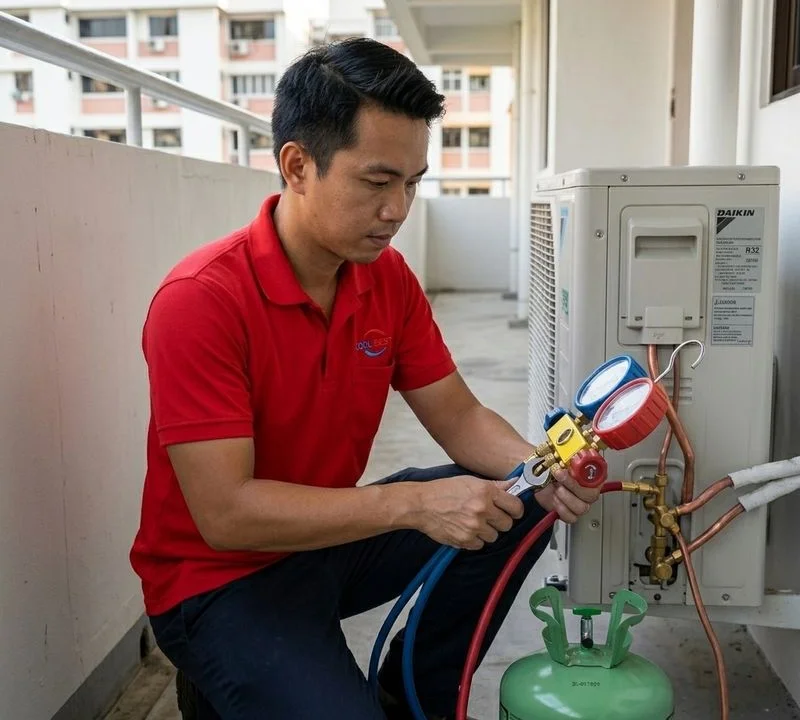
When You Actually Need A Gas Top-Up
Most aircon units that blow warm air or cool weakly need refrigerant attention — but not always a top-up. Before we refill, we pressure-test.
Real gas top-up cases:
- Unit is 5+ years old and hasn’t had a top-up before — refrigerant has slowly diffused over time
- Recent repair replaced a component that required a partial purge (e.g. fan motor, PCB)
- Pressure reading is 10–20% below spec but holds under nitrogen test (no leak)
Cases that look like a top-up but aren’t:
- Unit that was topped up 2–3 months ago and is cooling weakly again — that’s a leak, not a top-up issue
- Rapid pressure drop on the nitrogen test — seal the leak first, then refill
- Weak cooling with normal pressure — probably a clogged coil (chemical wash territory)
We run this test in the first 15 minutes on-site. If a top-up isn’t the right answer, we tell you — and you pay only the S$50 diagnostic charge (waived if you proceed with the actual fix).
Refrigerants We Handle
| Type | Typical Systems | Price Range |
|---|---|---|
| R32 | Modern Daikin, Mitsubishi Starmex, Panasonic inverters (post-2016) | S$100–180 |
| R410A | Mid-generation units (2008–2015) | S$120–200 |
| R22 | Older pre-2015 units still in service (being phased out) | S$180–250 |
R22 is under Singapore’s phase-out plan — we still top up existing units where possible, but we’ll be honest about how long you can keep the system going before replacement becomes the better economic decision.
How The Job Runs On-Site
- Pressure check (10 minutes): manifold gauge set connected to the suction line. Current PSI recorded, compared against manufacturer spec.
- Nitrogen leak test (30 minutes): nitrogen introduced at 150 PSI, pressure watched for drop over 30 minutes. Any loss above 5 PSI = confirmed leak; we stop and quote the seal repair.
- Vacuum (15 minutes): if pressure holds, we vacuum down to ~500 microns to pull out moisture before refilling.
- Refrigerant charge (15 minutes): exact weight metered via electronic scale, matched to the pipe-run length and system spec.
- Test run (15 minutes): system powered up, suction and discharge pressures re-verified, cold-discharge temperature measured.
- Written report: pre/post PSI values and the refrigerant weight added are recorded on your invoice.
Total time: 60–90 minutes per system.
What You Get Afterwards
- Written report with pre-service and post-service PSI
- Refrigerant type and grams added on the invoice
- Nitrogen leak test result (pass / fail, with pressure drop if any)
- 90-day workmanship warranty on the top-up — if the system loses significant pressure within 90 days, we return and investigate at no charge
Why We Won’t Top Up A Leaking System
Customers sometimes ask us to “just top it up and see how long it lasts”. We won’t do that for two reasons:
- Environmental: R410A and R22 are potent greenhouse gases. Releasing them into a leak is a 10-minute fix that costs the atmosphere for decades.
- Economic: a slow leak that loses 20 grams a month will swallow a S$180 top-up in 6 months. Sealing the leak costs S$80–200 depending on location — and then the top-up actually lasts.
It’s the same reason we won’t replace a capacitor without testing the fan motor first. Shortcuts cost more in the long run.