Air conditioning refrigerant does not get consumed like petrol in a car. Healthy aircons operate in a closed loop for years without losing a single drop. If you are researching the 5 Signs Your Aircon Needs a Gas Top-Up, a physical leak likely exists somewhere in your copper piping.
We founded Coolbest Aircon Servicing to deliver reliable cooling solutions across Singapore at affordable rates. This mission means educating homeowners about proper and effective maintenance.
Our technicians frequently see clients paying for repeated top-ups without ever solving the root cause. This temporary patch wastes money and severely damages your compressor over time.
This guide covers the definitive indicators of a leak and explains the correct diagnostic protocol.
Sign 1: Gradual Reduction In Cooling Power Over Weeks
A slow decline in cooling capacity over several weeks points directly to a micro-leak. Your unit felt ice-cold in January, but by April it barely manages to blow cool air.
We often find these tiny leaks take months to trigger a noticeable temperature difference. The gradual loss of pressure reduces the system’s ability to absorb heat from the room.
Before assuming your gas is low, always verify these basic components:
- Clean the primary air filters thoroughly.
- Ensure windows and doors remain tightly closed.
- Check the outdoor condenser for heavy dust buildup.
Our team recommends timing your cooling cycle after cleaning the filters. A healthy 9,000 BTU unit cools a standard Singapore bedroom in 15 to 20 minutes. Taking 45 minutes indicates a severe problem requiring professional attention.
Sign 2: Ice Forming On Copper Pipes Or Evaporator Coil
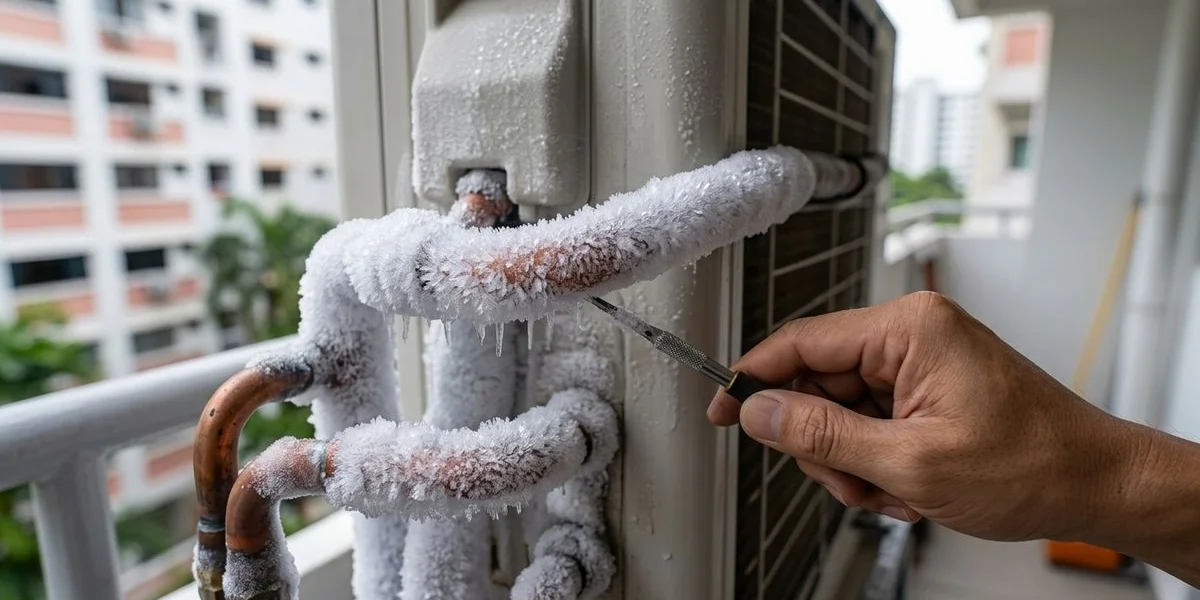
Solid ice or thick frost on the outdoor copper pipes is a guaranteed sign of low refrigerant. The thicker insulated line is the suction pipe connecting your indoor and outdoor units.
When refrigerant levels drop, the internal system dynamics change drastically:
- Pressure on the suction line drops significantly.
- Coil temperatures plummet well below 0°C.
- Singapore’s high humidity causes air condensation to freeze instantly.
- Solid ice builds up rapidly on the exposed copper.
We strongly advise turning the system off immediately to prevent catastrophic compressor failure. Running a frozen aircon forces the motor to work harder without vital lubrication.
Never chip away this ice with sharp tools. A simple scratch easily punctures the thin copper lines.
Sign 3: Faint Hissing Sound Near The Indoor Unit
Escaping refrigerant gas often produces a distinct hissing or bubbling noise near the leak source. Modern R32 systems operate at higher pressures than older models, making these leaks slightly easier to hear.
These audible leaks typically occur at specific failure points:
- The flare connection joining the copper pipe to the indoor unit.
- The outdoor service valve assembly.
- A micro-pinhole corroded directly into the evaporator coil.
Our diagnostic tools pinpoint the exact origin of these faint sounds. If you notice a new hissing noise combined with weak airflow, book a professional check immediately. Ignoring the sound allows the system to run completely dry.
Sign 4: Aircon Runs Constantly Without Reaching Set Temperature
A compressor running non-stop without hitting the target temperature signals a severe lack of cooling power. You set the remote to 22°C, but the room stubbornly stays at 26°C.
A fully charged system reaches the desired temperature quickly and then cycles off to save power. An undercharged unit simply lacks the chemical means to remove indoor heat effectively.
We see many homeowners ignore this constant humming until the motor completely burns out. The compressor relies on the returning cool gas to prevent overheating. Continuous operation without this return gas guarantees expensive mechanical damage.
Sign 5: Unusually High Electricity Bill
Faulty aircons drain power rapidly, causing your monthly electricity bill to spike by 20 to 40 percent. The system runs twice as long just to provide half the normal cooling output.
With the SP Group electricity tariff hitting 29.72 cents per kWh in Q2 2026, these wasted hours add up fast.
Our clients often report bill increases of $30 to $50 a month before realising their aircon has a leak. Cross-check your utility statement against your daily usage habits.
If the bill jumped without any extra running time, low gas is a highly probable culprit.
Why Top-Up Alone Isn’t The Full Fix
Pumping new gas into a leaking system guarantees you will pay for the exact same service a few months later. Many contractors offer a fast refill and leave without locating the actual hole.
We consider a genuine repair impossible without conducting a proper pressure test first. A legitimate technician always verifies the system integrity using a strict diagnostic procedure.
A proper intervention involves several mandatory steps:
- Measure the current baseline pressure inside the system.
- Perform a nitrogen pressure test for 30 minutes to detect the exact leak rate.
- Locate and seal the specific failure point.
- Recharge the system precisely to manufacturer specifications.
- Re-test the equipment under a full cooling load.
Walk away immediately from any quote promising a quick 20-minute fix for $120.
The Honest Leak-First Protocol
A professional diagnostic service isolates the fault before adding a single drop of new gas. This transparent quotation process protects you from hidden fees and repeated breakdowns.
Our standard diagnostic package includes a rigorous 30-minute nitrogen hold test. This precise procedure determines exactly how fast the gas is escaping. If we detect no leak, the technician proceeds straight to a standard top-up.
When a fault is found, expect these average repair costs in Singapore:
- Flare connection: Re-flaring the copper tip usually costs $60 to $100 plus the refill.
- Evaporator coil pinhole: Applying epoxy seals or replacing the coil runs between $150 and $400.
- Schrader valve: Replacing a leaky service port core requires $40 to $80.
- Capillary line: Specialist welding repairs average $200 to $350.
You retain full control over the final repair decision before any extra work begins.
What’s NOT A Sign Of Low Refrigerant
Certain common aircon faults have nothing to do with your gas levels. Misdiagnosing these issues leads to wasted money on entirely unnecessary top-ups.
We always rule out these specific faults during our initial visual inspection. Proper identification saves time and restores your cooling efficiency faster.
Do not request a gas refill if you experience these specific symptoms:
- Musty smells: This indicates biofilm buildup requiring a thorough $140 chemical wash.
- Water dripping: Indoor leakage means a clogged drainage pipe needs high-pressure flushing.
- Loud rattling noises: Mechanical sounds point to a failing fan motor or loose plastic casing.
- Blinking error codes: Flashing lights relate to faulty printed circuit boards or broken temperature sensors.
- Complete power failure: A unit that refuses to turn on suffers from severe electrical issues.
Refrigerant Top-Up Pricing
The final cost of a refill depends heavily on the specific type of chemical your system requires. Singapore’s National Environment Agency phased out high-emission R410A units for households in late 2022.
Modern residential systems now run on R32, which is roughly 10 percent more energy-efficient.
Our technicians carry all major gas types to service both new installations and legacy models. Pricing reflects the current market rates for regulated industrial chemicals.
| Refrigerant | Top-Up Only (Leak-Free) | Leak Check + Top-Up |
|---|---|---|
| R32 | S$100 to S$130 | S$150 to S$180 |
| R410A | S$120 to S$180 | S$180 to S$230 |
| R22 (phase-out) | S$180 to S$250 | S$230 to S$300 |
Sealing a discovered leak adds an estimated $100 to $350 to the final bill.
Don’t DIY Refrigerant Top-Up
Handling pressurised cooling gases without professional training is illegal and highly dangerous. Singapore law strictly regulates who can purchase and transport these industrial chemicals.
Attempting a self-repair exposes you and your equipment to severe risks:
- R32 is mildly flammable and requires specific A2L safety handling protocols.
- Over-pressurising the copper lines will burst the delicate internal rubber seals.
- Mixing different gas types instantly ruins the compressor motor.
- Unlicensed tampering voids your manufacturer warranty completely.
We utilize specialised digital manifolds that cost far more than a standard service call. Accurate measurement is critical to prevent the system from overloading.
Book A Leak-First Top-Up
Stop paying for temporary fixes and get your system pressure tested properly. Sending a photo of your unit’s specification label helps us prepare the right equipment.
Our service desk will reply with a straightforward quote covering the diagnostic and the refill. Secure your appointment today to address the 5 Signs Your Aircon Needs a Gas Top-Up and restore your cooling efficiency safely.
Gas top-up service, WhatsApp +65 9182 5233.