Understanding the true Aircon Gas Top-Up Process: What Actually Happens behind the scenes is vital for protecting your cooling system and your wallet.
We regularly encounter homeowners and business managers who have fallen victim to unnecessary maintenance charges. A 2026 report by local consumer watchdogs highlights that unnecessary gas refills remain one of the most pervasive service frauds across Singapore.
”Many consumers unknowingly pay for ‘top-ups’ when their aircon actually has a permanent leak, leading to endless recurring costs.”
Our team at Coolbest Aircon Servicing follows a strict, diagnostic-first approach to ensure you only pay for exactly what your unit needs.
This comprehensive guide breaks down the legitimate seven-step procedure. You will learn exactly how to verify if your technician is performing the job correctly or simply cutting corners.
Step 1: Measure Current Suction & Discharge Pressure (5 min)
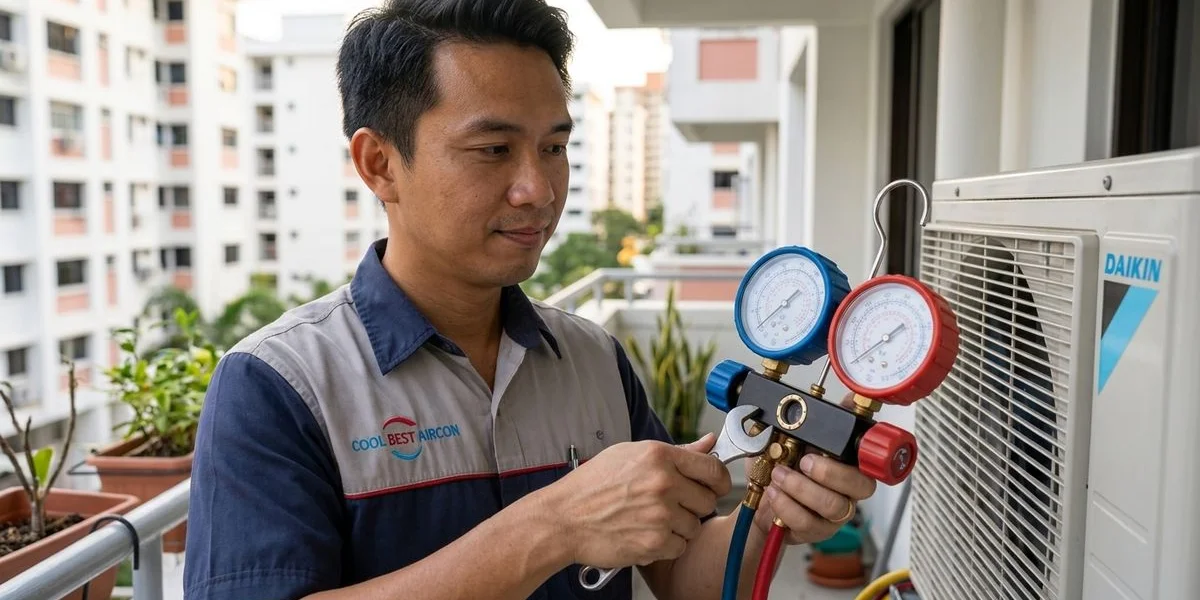
Our diagnostic process always begins with connecting a high-precision digital manifold gauge, such as the Testo 550s, to your outdoor unit’s service ports. This instrument takes two precise readings to determine exactly how much pressure is inside.
- Low-side (suction): Typically ranges between 115 and 140 PSI for modern R32 inverter systems operating in cooling mode.
- High-side (discharge): Usually climbs to between 380 and 450 PSI for R32 units.
We evaluate these specific numbers to confirm an under-charge condition. If a low-side reading shows only 40 PSI, the system is clearly missing a significant volume of refrigerant.
You should always ask to see the gauge for yourself. Legitimate technicians will gladly show you the exact pressure readings on the digital display.
Step 2: Record Current Refrigerant Level
Our technicians calculate the exact amount of missing gas based on measured pressure, ambient temperature, and your specific system model. The goal is to work out how many grams of refrigerant are missing.
We carefully compare factory specifications against the current capacity. For context, typical factory charges include:
- 9,000 BTU systems (e.g., Daikin, Mitsubishi): 600 to 800 grams.
- 12,000 BTU to 18,000 BTU systems: 900 to 1,200 grams.
If a 9,000 BTU unit calculation shows it is down to 500 grams, the system is approximately 25% low. This specific deficit usually matches the observed cooling loss in your room.
Calculating by weight rather than just guessing ensures compliance with the National Environment Agency (NEA) guidelines for refrigerant handling.
Step 3: Nitrogen Pressure Leak Test (30-Min Hold)
Our protocol requires a strict nitrogen pressure test at 400 PSI to definitively locate any structural breaches. Here is the correct sequence of events:
- The technician evacuates the remaining refrigerant into a dedicated recovery cylinder, as venting gases into the atmosphere is strictly illegal in Singapore.
- The system is pressurised with inert nitrogen up to 400 PSI.
- This pressure is held for a full 30 minutes while being monitored on the gauge.
- If the pressure drops by more than 2 PSI, a structural leak is confirmed.
Nitrogen is used because it is an affordable, inert gas that will not contaminate the delicate internal components.
We use this method because pressure-testing with actual refrigerant is wasteful and expensive. If your technician skips this critical 30-minute hold, you are simply paying to refill a leaking system. The newly added gas will escape into the atmosphere within weeks.
Step 4: If Leak Found - Seal Before Top-Up
Our team will locate the exact source of the leak and seal it before any new gas is added if the nitrogen test indicates a pressure drop. Pinpointing the fault requires several reliable methods.
- Bubble test: Applying a specialized soap solution directly onto suspect copper joints.
- Electronic leak detector: Sweeping the area with a sensor that sniffs for microscopic refrigerant residue.
- UV dye: Injecting a trace dye that illuminates under an ultraviolet light.
We frequently discover leaks at the flare connections of older HDB flats. Common fixes include:
- Flare connection: Cutting and re-flaring the copper pipe, then tightening it to the manufacturer’s specified torque. Labour typically costs S$60 to S$100.
- Schrader valve: Replacing the faulty valve core costs between S$40 and S$80.
- Evaporator coil pinhole: Applying a temporary epoxy seal lasts 1 to 2 years, while a full coil replacement offers a permanent solution.
- Capillary tube: This requires a specialist braze repair.
Our technicians will quote the sealing job separately. You must approve the final cost before any repair work proceeds.
Step 5: If No Leak - Add Refrigerant To Spec PSI
We proceed with the final refrigerant refill using a digital scale only if the 30-minute nitrogen test holds perfectly steady. The following steps ensure a safe and accurate charge:
- The safe, inert nitrogen is recovered and discarded.
- The system is vacuumed down to 500 microns to extract all damaging moisture and air.
- A 10-minute vacuum hold confirms that no new leaks have formed post-recovery.
- Refrigerant is released from the canister using an electronic weighing scale, charging precisely by weight rather than relying on pressure alone.
- The filling stops exactly at the factory-specified weight for your exact model.
Our use of a digital scale guarantees accuracy because internal pressure fluctuates significantly with Singapore’s hot ambient temperatures. Since the NEA banned the import of high-GWP R410A units in 2022, ensuring precise handling of modern R32 systems has become even more critical for energy efficiency.
Step 6: Re-Test Pressure Under Load (10 min)
Our final verification involves testing the equipment under a real cooling load to ensure the temperature output matches the factory specifications. The process involves:
- Powering on the air conditioner and setting it to the coolest mode.
- Re-measuring the suction and discharge pressures to ensure stability.
- Checking the cold-discharge air temperature directly at the indoor fancoil unit.
- Comparing these results to the manufacturer specification sheet, which should match within a 5% margin.
We also calculate the Delta T by measuring the temperature difference between the return air and the supply air. A healthy system in Singapore should display a Delta T of approximately 8 to 10 degrees Celsius.
You can ask to see these specific numbers at any time. Legitimate technicians will carefully document these readings on your service report.
Step 7: Written Report
Our company provides a comprehensive written report upon completion of every job to document the exact amount of gas added and pressure readings. A proper top-up invoice must clearly document the following details:
- The date of service and the attending technician’s name.
- Your specific unit model and the registered serial number.
- The exact type of refrigerant used and the precise amount added in grams.
- The pre-service and post-service pressure readings.
- The definitive results of the nitrogen leak test.
- A clearly stated warranty period, which should be a minimum of 30 days on the top-up itself.
We strongly advocate that providing this level of documentation protects consumers from future disputes. This transparent reporting standard aligns with the best practices recommended by the Consumers Association of Singapore.
Red Flags: Technicians Who Skip Steps
We strongly advise consumers to walk away from service providers who skip the gauge test or refuse to perform a nitrogen leak check. The “cheap top-up scam” is unfortunately common, often starting with an unbelievable $20 promotional cleaning rate.
Watch out for these undeniable red flags:
- No gauge set visible: The technician is simply eyeballing the unit and guessing the levels.
- No nitrogen test performed: You are essentially paying for gas that will inevitably escape again.
- ”Top-up only, no diagnostic” stated upfront: This guarantees that no leak check will occur, and a repeat breakdown is imminent.
- Cash only with no invoice provided: You will have zero recourse if the newly added refrigerant leaks out within days.
- ”Trust the system is fine” claims: Refusing to show actual pressure readings is a major warning sign.
Our daily field operations show that these traps cost homeowners hundreds of wasted dollars. You must report unscrupulous companies to the Consumers Association of Singapore (CASE) if you encounter these deceptive practices.
How Long Does A Gas Top-Up Take?
Our scheduling team provides clear time estimates, noting that a standard leak-free top-up takes 45 to 60 minutes, while complex repairs can take over two hours. The duration of the service depends heavily on the condition of your unit.
| Scenario | Estimated Duration |
|---|---|
| Standard leak-free R32 top-up | 45 to 60 minutes |
| Top-up with a minor flare joint leak | 90 to 120 minutes |
| Top-up involving a significant coil pinhole leak | 2+ hours, often requiring a rescheduled visit |
| Legacy R22 system service | 60 to 90 minutes, requiring prior supply confirmation |
We allocate these specific timeframes to allow our specialists to perform the necessary safety checks without rushing the procedure. Rushing through a high-pressure gas transfer is extremely dangerous and leads to poor system performance.
What You Pay
Our pricing structure is completely transparent, with a standard R32 top-up costing between $100 and $130 in the 2026 Singapore market. You will never face hidden fees or surprise charges.
| Service Type | Typical Cost (SGD) |
|---|---|
| R32 top-up (leak-free maintenance) | $100 to $130 |
| R32 top-up including a nitrogen leak test and basic seal | $200 to $300 |
| R410A top-up (legacy systems) | $120 to $180 |
| R22 top-up (subject to limited market supply) | $180 to $250 |
| Comprehensive diagnostic only (no top-up performed) | $50 (fully waived if the top-up proceeds) |
We ensure all clients receive a detailed breakdown of these costs before any tools are lifted. This upfront clarity eliminates the risk of post-service price shocks.
Warranty On Gas Top-Up
Our service guarantee at Coolbest includes a 30-day workmanship warranty covering the specific top-up and sealing work we perform. The standard coverage includes:
- A 30-day workmanship warranty covering the top-up itself, valid if the gas escapes due to our specific flare or seal work.
- No coverage on the newly added gas if a completely new, unrelated leak appears in a different section of the aging pipework.
We must emphasize that future leaks often represent a separate mechanical fault, not a failure in workmanship. Contractors who advertise a “lifetime gas warranty” on a basic top-up are being highly misleading. No engineering professional can realistically warrant a deteriorating copper pipe against unpredictable structural wear.
Book A Top-Up
Our customer support team is ready to assist you with transparent scheduling and pricing when you message us on WhatsApp at +65 9182 5233. Send your unit model and current symptoms directly to us, and the team will quote the leak test and top-up before arrival.
We encourage you to reach out today to secure your appointment.
Please visit our dedicated Gas top-up service page for more detailed information.