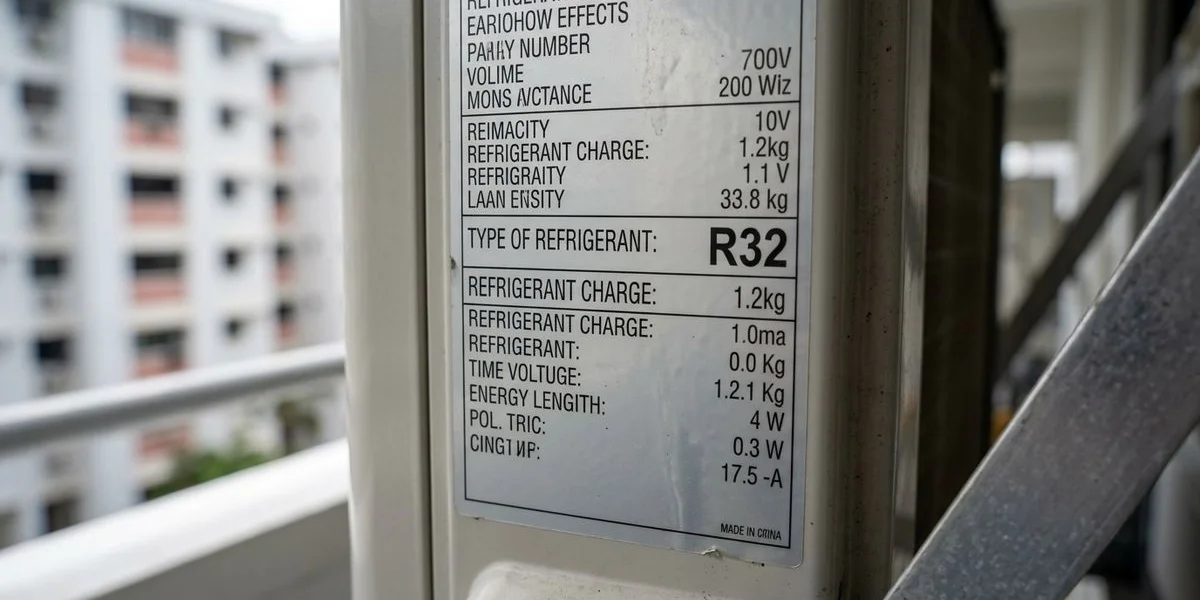
We founded Coolbest Aircon Servicing to deliver reliable, high-quality cooling solutions to communities across Singapore at affordable rates. Three refrigerant types currently circulate in local residential and SME systems.
Our 2026 data shows that your unit’s specific gas dictates top-up costs, part availability, and your replacement timeline.
This practical guide provides the exact details you need.
The Three Refrigerants In Singapore
Your air conditioning system will use either R22, R410A, or R32. Our technicians check this specification first before providing any service quote. The National Environment Agency (NEA) strictly regulates these gases based on their environmental impact.
| Refrigerant | Era | Status | Typical Top-Up Cost (SGD) |
|---|---|---|---|
| R22 | 1990s to 2010 | Phased out, limited stock | S$180 to S$250 |
| R410A | 2010 to 2018 | Current, supply tightening | S$80 to S$165 |
| R32 | 2018 onwards | Modern standard | S$100 to S$220 |
How To Identify Your Refrigerant
You can find your refrigerant type printed clearly on the sticker located on your outdoor condenser. We always recommend checking this black-on-silver label first. Manufacturers like Daikin and Panasonic typically list the factory charge weight in grams, the exact gas model, and the unit model number.
Our field teams know that outdoor labels often weather beyond reading in Singapore’s tropical climate. The indoor unit usually features a smaller sticker on the side panel inside the front cover.
When in doubt, use these general age guidelines:
- Pre-2010 aircons generally use R22.
- Systems installed between 2010 and 2018 typically use R410A.
- Units manufactured from 2018 onward almost exclusively run on R32.
R22: The Phase-Out Story
The Montreal Protocol banned R22 globally because it severely depletes the ozone layer. Our industry follows strict NEA guidelines to phase out this harmful gas entirely.
The Timeline of R22 Restrictions
Singapore implemented a structured reduction plan for residential and commercial spaces. High costs now reflect this deliberate market shift.
- 2010: The government stopped new equipment imports.
- 2015: Servicing stock began a rapid decline.
- 2019 to 2020: Supply constraints caused prices to spike up to three times normal rates.
- 2026: Stock is minimal, creating premium pricing for any remaining supply.
Why You Should Budget for Replacement
We advise clients to avoid sinking money into failing legacy systems. Each R22 top-up currently costs between S$180 and S$250 due to severe scarcity.
Attempting a leak repair and top-up cycle becomes uneconomic past the second time. Most insurance assessors and HDB guidelines now consider R22 systems to be at the end of their operational life. Your most cost-effective move is to budget for an R32 replacement at the next major failure.
R410A: The Bridge Generation
Manufacturers used R410A as a transitional gas to replace R22 from 2010 onward. Our experts note that while it stops ozone depletion, it carries a high global warming potential of 2,088.
Current Market Status for R410A
The industry views R410A as a reliable but outgoing technology in 2026. Routine servicing remains accessible for most households.
- Top-up procedures are routine and generally cost S$80 to S$165.
- Replacement parts remain widely available across Singapore.
- A well-maintained system can run reliably for another five to eight years.
- You do not need an urgent replacement unless the compressor fails entirely.
The Transition To Newer Standards
We anticipate R410A supplies will slowly tighten as the market moves away from high-GWP gases. Recent global agreements require nations to phase down hydrofluorocarbons. Your existing R410A unit remains perfectly legal to operate, but new installations have shifted to greener alternatives.
R32: The Modern Standard
R32 serves as the default refrigerant for nearly all new air conditioning systems in Singapore today. We highly recommend this gas for any new installation or full system replacement.
Key Efficiency Benefits
The National Environment Agency actively encourages the adoption of R32 to meet national sustainability targets. This single-component gas dominates the market for several practical reasons.
- Lower Environmental Impact: The global warming potential sits at 675, making it roughly three times better than R410A.
- Higher Energy Efficiency: Units consume 10 to 15 percent less electricity, directly lowering your monthly utility bills.
- Easier Servicing: Single-component gases are much easier to top up correctly compared to complex blends.
- Superior Cooling: The gas features excellent heat transfer properties for faster room cooling.
Daikin and Industry Adoption
We watched the industry transform when Daikin released hundreds of its R32 patents for free use worldwide. This move allowed multiple brands to develop highly efficient, 5-tick NEA-rated units. You will notice that modern R32 systems feature more compact outdoor units due to reduced refrigerant charge requirements.
Can You Convert Between Refrigerants?
You absolutely cannot convert an existing system to use a different refrigerant. Our certified technicians strictly follow manufacturer specifications, as each system requires a specific chemical balance.
You cannot simply upgrade an R22 system by pumping R32 into the pipes.
- The compressor lubricant is completely refrigerant-specific, such as POE oil versus mineral oil.
- Copper line pressure requirements differ drastically between older and newer gases.
- Printed circuit boards and sensor calibrations are designed for one precise operating range.
- Attempting any conversion instantly voids your warranty and will permanently damage the compressor.
If you want the efficiency benefits of R32, you must purchase an entirely new air conditioning system.
The Economic Break-Even: R22 Top-Up vs Replace
Calculating the break-even point helps you decide whether to repair an old unit or invest in new technology. We use a straightforward framework to help homeowners make financially sound choices.
| Scenario | Action |
|---|---|
| R22 system, 10+ years, first top-up request | Consider replacement. Each top-up buys roughly 1 year of service; a new unit provides 10+ years. |
| R22 system, 8 years, leak repair feasible | Borderline. If repair and top-up total under S$400, it makes sense for 1 to 2 more years. |
| R22 system with compressor or PCB issues | Replace immediately. Parts are expensive, and the system is past its economic life. |
| R410A system, any age, no recurring leaks | Top-up every few years as needed. You have no rush to replace the unit. |
| R32 system | Top-up as needed. Replacement is not a consideration. |
With 2026 electricity tariffs averaging 29 cents per kilowatt-hour, running an old R22 system costs significantly more than operating a new 5-tick R32 inverter model. Your long-term savings often justify the immediate replacement cost.
Why Technicians Charge More For R22
Service costs for R22 remain exceptionally high because the physical stockpile in Singapore is extremely limited. Our procurement team constantly manages premium pricing just to secure legitimate inventory.
Some wholesale dealers now enforce minimum purchase quantities, which artificially drives up the cost for single residential top-ups. Technicians also face higher workmanship risks when dealing with legacy units.
Here are the primary factors driving up the cost:
- Severe supply chain restrictions across Singapore.
- Added time required for safe A2L recovery protocols.
- Higher risk of damaging older seals and degraded compressor oil.
If anyone quotes you an R22 top-up at S$80, you should walk away immediately. They are likely using recovered or recycled gas of uncertain quality, which can cause permanent system failure.
Is R32 Dangerous Because It’s Flammable?
R32 carries an A2L classification, meaning it is only mildly flammable under very specific conditions. We assure you that this gas never ignites during normal household cooling operations.
Understanding SCDF Safety Protocols
The Singapore Civil Defence Force formally approved R32 for residential multi-split systems after extensive safety testing. Ignition requires a massive concentration of gas and a direct, active spark in a highly confined space.
- The chemical only ignites if exposed to an active open flame or welding equipment.
- Modern units are thoroughly sealed and tested against leaks.
- NEA-certified technicians follow rigorous A2L safety protocols, ensuring proper ventilation.
- Installers keep all open flames far away from the work area during setup.
Every modern installation in Singapore strictly adheres to these legal safety standards. Statistical data proves that a standard R32 aircon is significantly safer than your kitchen gas stove.
When To Book A Top-Up
Your system will show clear physical symptoms when the refrigerant levels drop too low. Our service calls frequently begin after a homeowner notices a gradual reduction in cooling power over several weeks.
Watch for these specific warning signs:
- Solid ice forming on the copper pipes near your outdoor unit.
- A faint hissing sound coming directly from the indoor blower.
- Electricity bills suddenly climbing while your room stays warm.
You can learn more by reading our full guide on signs your aircon needs gas top-up.
Book A Gas Top-Up
Contact us today to schedule a professional inspection and secure your cooling performance. We provide transparent pricing and expert handling for all common residential units.
You can easily secure your Gas top-up service online. Our dispatch team will confirm your exact refrigerant type before arrival and quote accordingly.
Send a quick message via WhatsApp +65 9182 5233 to speak with support immediately.