Selecting a new air conditioning system is a critical decision that impacts your comfort and electricity bills for the next 10 to 15 years. Making the wrong choice often leads to frustrating repair calls and inflated utility costs.
Coolbest Aircon Servicing built its foundation on a mission to deliver reliable, high-quality cooling solutions to communities across Singapore at affordable prices. We understand that choosing the right system type matters far more than just picking a popular brand.
Recent data shows that installing a National Environment Agency (NEA) 5-tick rated model can save a typical Singapore household over S$1,300 annually compared to older units. This guide provides an honest, updated comparison across the three main systems used locally.
You will learn exactly which option suits your specific property constraints and budget.
Quick Answer By Property Type
The most suitable air conditioner depends directly on your building management rules and existing structural layout.
We always check the property type first before recommending a specific cooling solution. Newer properties often restrict outdoor modifications, while older estates might lack modern electrical loading.
| Property Type | Best Fit | Key Notes |
|---|---|---|
| HDB BTO (post-2003) | Split System | Pre-installed compressor brackets exist; structural hacking is strictly forbidden. |
| Older HDB (pre-2000) | Split or Window | Window installation is only legal if the concrete aperture already exists. |
| Condominium | Split + Cassette | Management Corporation Strata Title (MCST) approval is mandatory for outdoor changes. |
| Landed House | Mixed Systems | Roof condenser space allows for high-capacity multi-split configurations. |
| Shophouse or Studio | Window or Split | Floor and wall space are at a premium, making compact units essential. |
Split System: The Default
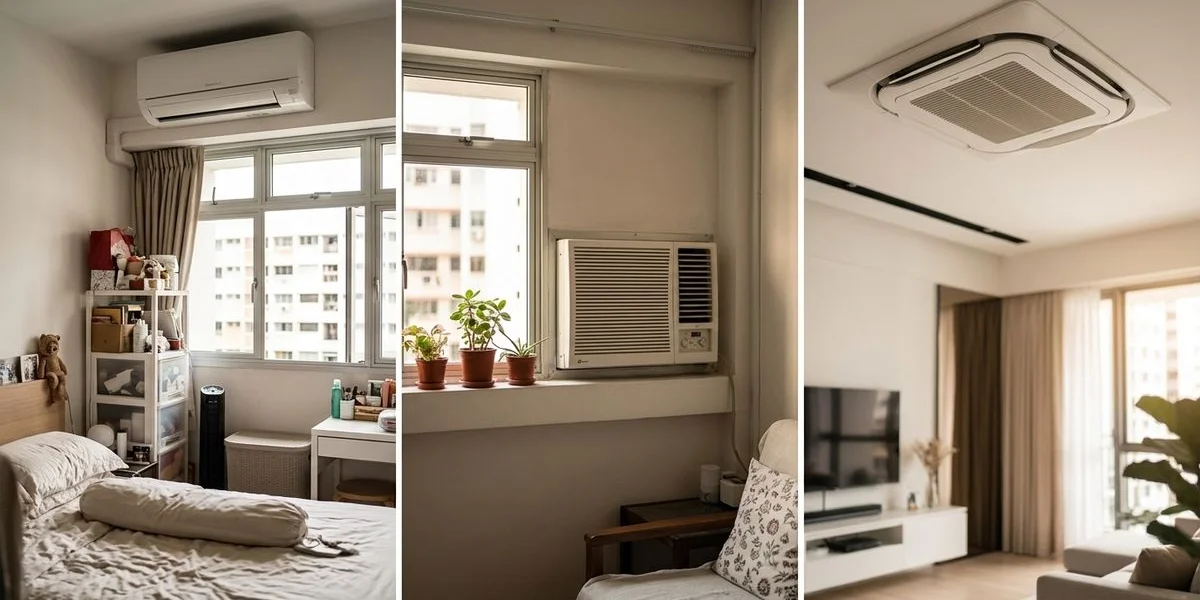
A split system features a distinct indoor fan coil and an outdoor compressor, making it the most practical and popular choice in Singapore. This two-part configuration keeps the noisy mechanical parts outside your living space.
Our technicians install hundreds of these units every year due to their unmatched energy efficiency. Modern inverter models, such as the Daikin iSmileEco series, consistently achieve the highest NEA 5-tick ratings.
Here are the main advantages of a split setup:
- Whisper-quiet operation: The indoor fan coil runs at roughly 25 decibels, which is quieter than a library.
- Maximum energy savings: A 5-tick model costs about S$3.26 per day to run for eight hours, cutting bills significantly.
- Government subsidies: Buyers can currently offset costs using the S$400 Climate Voucher for eligible 5-tick systems.
- Total compliance: These systems meet all current Housing and Development Board (HDB) regulations, including the strict 110kg maximum weight limit for external service ledges.
Despite the benefits, split systems come with a few drawbacks:
- Outdoor space required: You must place the condenser on a designated service ledge or bracket.
- Complex installation: The process involves drilling, laying copper piping, and installing trunking.
- Higher initial cost: Prices are generally steeper than single-box window units.
In 2026, a standard System 1 split installation costs between S$1,050 and S$1,700. If you need a System 3 configuration for multiple rooms, expect to pay between S$2,700 and S$3,600.
Window Unit: The Legacy Option
Window units are compact, single-box air conditioners that house all components together and sit directly inside a wall opening. They remain a budget-friendly option primarily for older estates and commercial shophouses.
We see these units most often in mature HDB towns like Queenstown and Toa Payoh. The installation process is straightforward because it requires no extensive copper piping or trunking.
Consider these benefits if you have a compatible space:
- Low upfront cost: A complete installation ranges from S$500 to S$900 depending on the required BTU capacity.
- Fast deployment: Technicians can complete a unit-for-unit swap in under two hours.
- Cheaper servicing: Routine maintenance is usually faster and costs less than servicing a complex multi-split system.
However, window models share several significant disadvantages:
- High noise levels: Operating at 40 to 45 decibels, the compressor runs inside the room and sounds like a humming refrigerator.
- Poor energy efficiency: These models max out at a 3-tick NEA rating, doubling your daily electricity costs compared to a 5-tick split system.
- Blocked natural light: The bulky box occupies valuable window space and reduces ventilation.
- Strict limitations: Newer HDB Build-To-Order (BTO) flats simply do not have compatible window apertures.
These units are best suited for temporary rental setups or budget-conscious commercial retrofits where a 15-amp power point already exists.
Cassette: The Condo/Landed Premium
Cassette aircons are powerful, ceiling-mounted units that deliver even, four-way airflow across expansive spaces. They are the premium standard for living rooms in luxury condominiums and landed homes with high ceilings.
Our commercial clients frequently request these systems for open-plan offices and restaurants. Brands like LG and Panasonic offer advanced cassette models capable of reaching up to 50,000 BTU, which is double the maximum capacity of a standard wall-mounted split unit.
The primary advantages of a cassette installation include:
- Superior air distribution: The four-way louvers cool large zones evenly without creating cold drafts.
- Sleek aesthetics: Only the flush square grille remains visible, keeping your walls completely free for artwork or shelving.
- High cooling capacity: One large cassette can comfortably cool a massive living and dining area.
Before choosing a cassette, you must evaluate these installation challenges:
- Ceiling height requirements: Your property needs a minimum ceiling height of 2.7 meters and at least 30 centimeters of internal clearance (plenum space) to hide the unit.
- Expensive ceiling work: Installation costs range from S$1,500 to S$3,000 per unit because it requires cutting and reinforcing a false ceiling.
- Messy maintenance: Accessing the drainage pump and internal components requires working directly above your living space.
Due to the false ceiling requirement and strict external bracket constraints, cassette systems are rarely approved for standard HDB flats.
Comparison Summary
Reviewing cost, noise, and efficiency side-by-side reveals exactly which system matches your space. The data below reflects average 2026 market rates and technical specifications in Singapore.
We strongly advise checking your building management rules before finalizing any purchase based on this table. Some condominiums have strict visual guidelines regarding outdoor condenser placement.
| Factor | Split System | Window Unit | Cassette System |
|---|---|---|---|
| Installed Cost (SGD) | $1,050 to $3,600 | $500 to $900 | $1,500 to $3,000+ |
| Noise Level (dB) | 25 to 28 | 40 to 45 | 32 to 35 |
| Max Efficiency | 5 Ticks | 3 Ticks | 4 to 5 Ticks |
| Install Time | 1 Day | 2 to 4 Hours | 1 to 2 Days |
| HDB Approval | Standard | Rare (Pre-2000 only) | Extremely Rare |
| Maintenance/Year | $200 to $400 | $150 to $250 | $300 to $500 |
| Expected Lifespan | 10 to 15 Years | 7 to 10 Years | 12 to 18 Years |
Can I Install A Window Aircon In An HDB?
Yes, you can install a window aircon, but only in older HDB flats where a specific window aperture was originally built into the structural design. Modern HDB BTOs completed after 2003 do not feature these openings.
We always remind homeowners that hacking a reinforced concrete wall to create a new hole is strictly illegal. The HDB enforces heavy penalties for unauthorized structural modifications.
If your older flat supports a window unit, you must follow strict compliance rules:
- BCA Certification: You are legally required to hire a Building and Construction Authority (BCA) trained installer.
- Electrical Loading: The installer will ensure your home has the necessary 15-amp power point or a 20-amp double pole isolator ready for use.
- Proper Insulation: All pipes and joints must be insulated to prevent condensation and dripping water along common corridors.
Our site surveyors can verify your electrical loading capacity and structural limits during their first visit.
Which Is Quietest?
Split systems are definitively the quietest option, operating at a barely noticeable 25 to 28 decibels indoors. This near-silent operation is achieved by isolating the noisy compressor unit entirely outside the building.
Our customers frequently upgrade to split models specifically to improve their sleep quality. Here is how the three systems compare in daily operation:
- Split System (25 to 28 dB): Sounds like a quiet whisper or a gentle rustling of leaves.
- Cassette System (32 to 35 dB): Produces a soft, steady hum similar to a quiet library.
- Window Unit (40 to 45 dB): The loudest option, comparable to a running refrigerator.
Recommendation Flowchart
Finding your perfect aircon depends entirely on your room size, property rules, and daily usage habits. Use this verified 2026 guide to narrow down your choices instantly.
We base these specific recommendations on thousands of successful residential and commercial installations across the island. Identifying the right match prevents costly rework later.
- HDB Bedroom (Standard 9000 BTU): Choose a Split system. It offers the quietest sleep environment and the lowest running costs.
- HDB Living Room: Choose a Split system. A larger 18000 BTU unit or two smaller splits handle the space perfectly.
- Condo Bedroom: Choose a Split system. It complies easily with standard MCST regulations.
- Condo Living Room (3m+ ceiling): Choose a Cassette system for premium aesthetics, or a high-capacity Split system for a more economical installation.
- Landed Property (Multiple Rooms): Choose a Multi-split system. Connecting three or four indoor units to a single outdoor condenser maximizes space and efficiency.
- Older Shophouse (Strict Budget): Choose a Window unit, but only if the structural aperture already exists.
- Office or Restaurant: Choose a Cassette system. The four-way airflow cools large crowds efficiently without creating hot spots.
Book A Site Survey
We provide complimentary site surveys for new installations to ensure you get the exact cooling system your space requires.
Accurate planning prevents unexpected installation delays.
Our technicians will measure your rooms, check condenser bracket limits, and verify your electrical loading.
Contact our team today to schedule an appointment.
Book an installation survey via WhatsApp at +65 9182 5233.