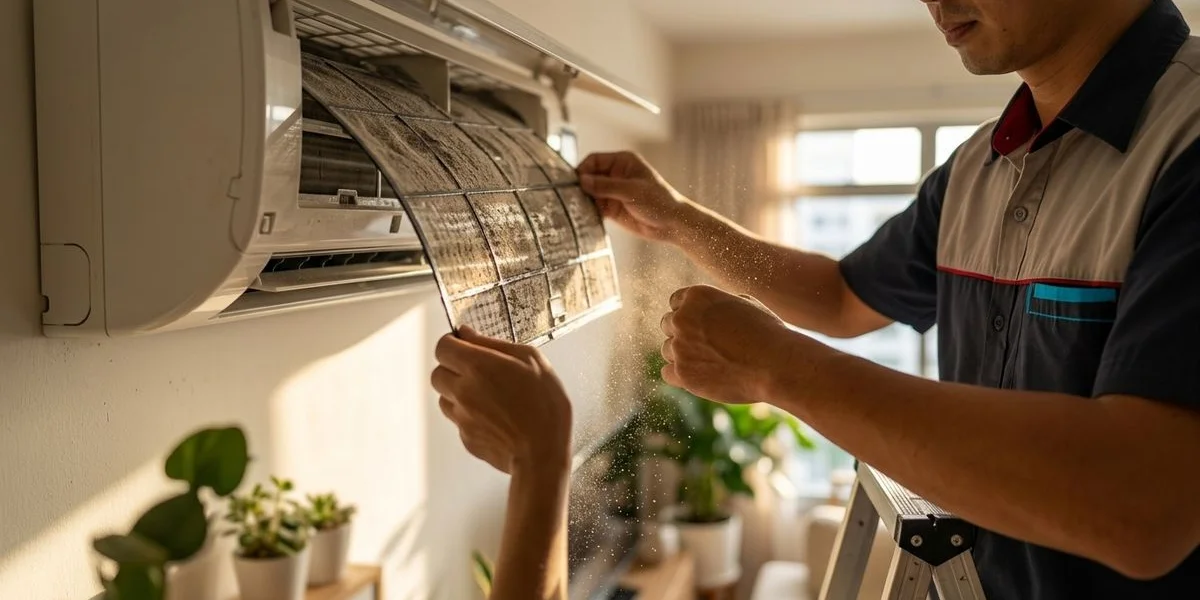
Recognising the 10 Signs Your Aircon Needs Professional Service will save you from unexpected breakdowns and costly replacements.
Every cooling unit gives clear early warning signals before a major component fails.
You just need to know exactly what to listen, smell, and look for.
Our team at Coolbest Aircon Servicing delivers reliable, high-quality cooling solutions to communities across Singapore at affordable rates.
The constant tropical heat forces local cooling systems to work incredibly hard year-round.
Ignoring minor symptoms often leads to sudden compressor deaths or flooded floors.
We have compiled the ten most common early warning indicators below.
Some issues allow you to wait a month, while others require same-day intervention.
Review this checklist to protect your home and keep your electricity bills in check.
1. The Musty / Wet-Clothes Smell
The fastest way to tell an aircon has gone too long without servicing is a distinct, sour odour blowing into the room.
That unpleasant smell comes from biofilm, which is a bacterial and mould layer thriving directly on the evaporator coil.
Our technicians frequently see Aspergillus mould growing rapidly inside units.
Singapore experiences an average humidity of 84%, creating the perfect breeding ground for these harmful spores.
Breathing in this contaminated air often triggers allergies and respiratory irritation for residents.
A standard service will not always clear heavy biofilm buildup.
You will typically need a full chemical wash to strip the coils bare and kill the bacteria completely.
The average 2026 market rate for a chemical wash in Singapore runs between $90 and $120 per unit.
| Odour Type | Likely Cause | Required Action |
|---|---|---|
| Musty / Wet Clothes | Mould and biofilm on coil | Chemical wash |
| Burning Plastic | Overheating wire or motor | Immediate power off, call technician |
2. Weak Airflow
If the fan sounds normal but air fails to reach the far end of the room, your blower wheel and coil fins are severely clogged.
Dust and pet dander pack tightly into the narrow spaces between the aluminium fins, choking off the air supply.
We always check the cubic feet per minute (CFM) output during routine inspections.
A drop in airflow forces the internal fan motor to strain against the blockage.
This extra resistance can easily shave years off the lifespan of your cooling system.
Quarterly maintenance prevents this thick dust blanket from forming.
Once the grey fuzz becomes clearly visible on the horizontal louvres, you are already overdue for a cleaning.
Ignoring weak airflow guarantees higher wear and tear on expensive internal parts.
Why Weak Airflow Ruins Components
- Strained Fan Motor: The motor works harder to push air through blocked fins.
- Ice Formation: Trapped cold air freezes the condensation on the coil.
- Poor Air Quality: The blockage traps fresh dust, releasing it slowly into your room.
3. Water Dripping From The Front
Water should always exit through the designated drainage pipe behind the unit, never from under the front cover.
If you see active drips inside your room, the condensate drainage line is completely blocked or the internal tray is tilted incorrectly.
Our priority is stopping the leak before it ruins your property.
Algae and a thick jelly-like substance frequently clog these drain pipes in tropical climates.
The condensation pan quickly overflows right into your living space.
You need to schedule a same-day service appointment before serious damage occurs.
Unchecked leaks will quickly destroy expensive laminate flooring, short-circuit nearby electronics, or rot your HDB ceiling boards.
A simple vacuum clearing of the drain pipe usually resolves the problem entirely.
Immediate Steps for a Leaking Aircon
- Turn off the power immediately at the remote and the wall switch.
- Move any electronics, rugs, or wooden furniture away from the drip zone.
- Place a wide plastic bucket directly under the leak.
- Contact a professional for an urgent drain line clearing.
4. Ice On The Copper Pipes
White frost building up on the copper suction line outside your unit almost always indicates dangerously low refrigerant pressure.
The lack of proper gas flow causes the evaporator coil temperatures to drop below freezing, turning normal condensation into solid ice.
We test the pressure levels of standard R32 and R410A refrigerants to find the exact deficit.
Sometimes your system just needs a standard gas top-up to restore the balance.
In other cases, a hidden micro-leak in the copper piping requires professional sealing and welding.
You must book a diagnostic visit immediately if you spot frost on the lines.
Continuing to run an iced-over unit will cause the expensive compressor to overheat and seize up entirely.
Replacing a burnt-out compressor often costs upwards of $500 in Singapore.
| Refrigerant Issue | Symptom | Typical Solution |
|---|---|---|
| Slight Gas Depletion | Mild frost, poor cooling | Standard gas top-up |
| Active Copper Leak | Heavy ice block, hissing sound | Locate leak, weld pipe, full regas |
5. Rising Electricity Bills
When your daily usage patterns remain exactly the same but your cooling bill climbs 15 to 30%, a fouled condenser coil is the likely culprit.
The machine must work significantly longer and harder to achieve your target room temperature.
Our clients are often shocked by how much a dirty filter costs them monthly.
The SP Group regulated electricity tariff for the second quarter of 2026 sits at 29.72 cents per kWh.
At these rates, an inefficient, struggling 12,000 BTU unit will bleed your wallet dry.
A basic $50 to $80 maintenance session often pays for itself through reduced energy consumption within just two months.
Clean coils transfer heat instantly, allowing the inverter technology to power down sooner.
Factors Spiking Your Energy Costs
- Dirty Filters: Blocked mesh increases energy consumption by up to 15%.
- Fouled Condenser Coils: Outdoor units covered in grime cannot release heat efficiently.
- Low Refrigerant: The compressor runs continuously without ever reaching the set temperature.
6. Blinking Error Lights
Modern Daikin, Mitsubishi, and Panasonic units flash specific LED patterns to communicate exact internal hardware faults.
If your wall unit is blinking, it has automatically shut down a function to protect itself from further electrical damage.
We use these diagnostic codes to arrive at your home with the correct replacement parts.
For example, a Daikin unit blinking the code U4 signals a communication error between the indoor and outdoor units.
Another common code, U0, indicates a severe refrigerant shortage.
Write down the exact behaviour of the lights, such as three slow green blinks followed by a pause.
You can then WhatsApp a quick photo or video of the panel directly to your technician.
This allows us to identify the specific error code before our van even leaves the depot.
Common Daikin Error Codes in Singapore
- U4: Transmission failure between indoor and outdoor units.
- U0: Refrigerant gas shortage triggering a system halt.
- A5: Abnormal temperature reading from the internal thermistor.
7. The Remote “Doesn’t Work”
Before assuming the remote control is completely dead, you must verify the power source and the unit’s receiver status.
A failure to turn on often points to a component inside the actual wall blower, rather than the handheld clicker.
Our technicians always check for fresh, high-quality batteries first.
Press the power button and watch the wall unit closely for any corresponding error blinks or faint beeps.
If the batteries are new and the unit still flashes a light, the signal receiver board has likely failed.
Replacing a faulty receiver in the fan coil requires a targeted electrical repair, not a general cleaning service.
A new infrared receiver board generally costs a fraction of buying a whole new air conditioning system.
| Test Step | Observation | Next Action |
|---|---|---|
| Change Batteries | Screen turns on, unit responds | Issue resolved |
| Press Power Button | Remote screen on, wall unit blinks | Call technician for receiver repair |
| Use Manual Override Button | Unit turns on normally | Replace remote control |
8. Unit Short-Cycles (On-Off-On-Off)
If the compressor switches on for two minutes, shuts off for one, and never settles into a rhythm, your system is short-cycling.
This rapid start-and-stop behaviour prevents the room from cooling and causes massive stress on electrical components.
We frequently diagnose short-cycling as a failing thermostat sensor that misreads the room temperature.
Low refrigerant can also cause the internal pressure switch to trip repeatedly as a safety mechanism.
Occasionally, the problem stems from installing an oversized, excessively powerful unit in a very small bedroom.
All three of these underlying causes demand a certified technician, as they are completely beyond a basic DIY fix.
Allowing a machine to short-cycle for weeks will quickly burn out the start capacitor and destroy the main compressor motor.
Dangers of Continuous Short-Cycling
- Spiking Power Bills: Compressors use the most electricity during the initial startup phase.
- Inadequate Dehumidification: The unit shuts off before it can extract sticky moisture from the air.
- Premature Motor Death: Constant electrical surges weaken the internal wiring.
9. Loud Rattling Or Grinding
A perfectly healthy aircon produces a smooth, quiet hum during operation.
Rattling usually indicates that the cylindrical blower wheel has collected heavy debris or that a plastic casing clip has snapped loose.
Our acoustic inspections can often pinpoint the exact failing part within seconds.
A harsh, metallic grinding noise almost always equals a dying fan motor bearing.
The replacement cost for a standard residential fan motor ranges from $200 to $350 in Singapore.
The longer you wait to address the grinding sound, the more dangerous the situation becomes.
A seizing motor draws excessive electrical current and will likely burn out the fragile Printed Circuit Board (PCB) right next to it.
| Noise Profile | Probable Source | Severity Level |
|---|---|---|
| Light Rattling | Loose front cover or dirty blower wheel | Low (Needs basic service) |
| High-Pitched Squeal | Worn fan belt or dry motor bearings | Medium (Needs lubrication/parts) |
| Deep Grinding | Failing compressor or broken fan motor | High (Immediate shutdown required) |
10. It’s Been Over 6 Months Since Last Service
Even without obvious visible symptoms, operating an aircon for more than six months without professional maintenance means you are overdue.
The National Environment Agency (NEA) strongly encourages regular servicing to maintain high energy efficiency standards across households.
Our local climate accelerates hardware degradation much faster than in temperate countries.
The relentless 80% humidity in Singapore speeds up acidic biofilm growth and causes internal metal components to rust silently.
A quarterly maintenance schedule is the absolute correct frequency for the vast majority of HDB and condo homes.
Sticking to a strict 90-day cleaning routine will easily add five to seven years to the functional life of your investment.
This routine care prevents minor quirks from evolving into catastrophic system failures.
Benefits of a Quarterly Servicing Schedule
- Consistent Cooling: Rooms reach the target temperature faster.
- Purer Air: Regular filter and coil washing removes trapped allergens.
- Warranty Protection: Many manufacturer warranties require proof of professional maintenance.
What You Can DIY (Between Services)
Basic maintenance between professional visits will keep your air quality high and reduce daily operational strain.
You must handle the external components gently to avoid snapping brittle plastic hinges.
We encourage homeowners to perform light cleaning tasks safely from the ground.
Focus on the simple, accessible parts while leaving the high-voltage electrical components to the experts.
- Wash the filter weekly by rinsing the basic mesh under a tap and letting it air-dry completely.
- Wipe the front panel monthly with a damp microfiber cloth to remove surface dust.
- Check the drainage outlet in your bathroom or balcony to ensure water flows clearly.
You should never attempt advanced procedures on your own.
Do not open the fan coil cover to access the wiring, avoid touching the bare copper pipes, and never spray generic hardware store chemicals directly onto the evaporator coil.
When To Call And What To Say
If you notice any of the early warning signs, you must act quickly to prevent further mechanical damage.
Clear communication helps dispatchers send the right expert with the correct spare parts.
Our booking process is designed to eliminate guesswork and prevent wasted trips.
WhatsApp us a clear photo of the indoor unit alongside a short 10-second video capturing the strange sound or water leak.
- Confirm whether the symptoms require a standard service, a complex repair, or a deep chemical wash.
- Provide you with a firm, fixed price quote before we even arrive at your property.
- Book you into the very next available same-day or next-day appointment slot.
Faster triage means you get cold air restored sooner with absolutely no surprise bills at the end of the visit.
Ready To Book A Fix For The 10 Signs Your Aircon Needs Professional Service?
Protecting your home from water damage and electrical faults starts with a single message.
Do not wait for a minor rattle to turn into a total system failure during the hottest month of the year.
Our technicians are standing by to solve your cooling issues today.
Every single repair comes with a guarantee to ensure your complete peace of mind.
We proudly stand behind our work.
WhatsApp +65 9182 5233 to secure your slot.
You will receive a 90-day warranty on every single fix, which is always written clearly on your final invoice.