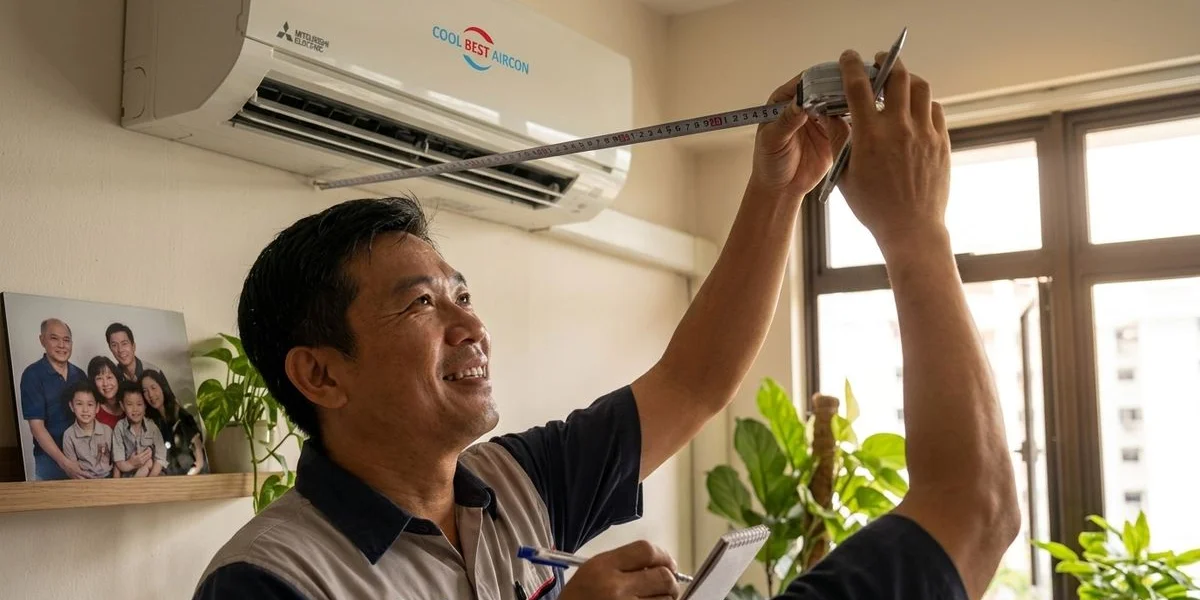
Our team at Coolbest Aircon Servicing sees the same expensive mistake every week across Singapore. Homeowners often guess their cooling needs instead of calculating them. We created this guide to eliminate that guesswork and deliver high-quality cooling solutions at affordable prices. How to Pick the Right BTU Size for Your Singapore Home comes down to a simple mathematical formula.
The Meteorological Service Singapore logged record-breaking 36-degree Celsius days recently in 2026. This intense heat demands precise equipment sizing. Pick a capacity too small, and the compressor runs endlessly without reaching your target temperature.
We want to help you avoid the opposite problem as well. Buying a unit that is too large increases your upfront costs and causes short-cycling. This leaves your bedroom feeling freezing cold but unpleasantly clammy.
Here is the exact method to size your air conditioning correctly for local humidity levels and sun exposure.
The Base Rule
The National Environment Agency (NEA) and local industry standards recommend a specific baseline for residential cooling. You need approximately 600 to 650 BTU per square metre of floor area in Singapore. We use this foundational metric before applying any environmental adjustments.
A standard 10-square-metre Housing and Development Board (HDB) bedroom requires a baseline of 6,000 to 6,500 BTU. This capacity handles a standard ceiling height and average indoor conditions.
Pro Tip: Do not use square footage calculations from American websites. Singapore’s 80% average relative humidity requires specific metric calculations to manage both heat and moisture effectively.
Three Singapore-Specific Adjustments
Our technicians always apply three specific environmental multipliers to the base rule. You will end up with an undersized system if you ignore these critical factors. These adjustments account for the unique architectural and weather challenges found across the island.
+15% For West-Facing Rooms
The afternoon sun creates severe heat gain through west-facing windows. Meteorological Service Singapore data shows that solar irradiance peaks intensely between 2 PM and 5 PM locally. Unshaded west-facing rooms heat up faster than a standard air conditioner can remove the thermal load.
We increase the capacity by 15% to combat this direct solar radiation. This extra power ensures your room reaches the set temperature even during the hottest parts of the day.
This 15% adjustment also applies to several other high-heat scenarios:
- Bedrooms featuring large, unshaded windows on any facade.
- Units located directly under a flat concrete roof.
- Top-floor HDB flats in towns like Punggol or Jurong West.
- Landed property attics with minimal roof insulation.
+10% For High Ceilings
A standard HDB Built-To-Order (BTO) flat features a ceiling height of 2.6 metres. You must increase your BTU calculation by 10% for any room with a ceiling exceeding 3 metres. We make this adjustment because the equipment must cool a significantly larger volume of air.
Cooling a room is about managing three-dimensional space, not just floor area. Higher ceilings trap hot air that eventually mixes with the cooled air below.
You must apply this 10% increase to the following spaces:
- Newer condominium units boasting 3.0 to 3.3-metre ceilings.
- Landed properties featuring elevated 3.5-metre designs.
- Trendy loft units and double-volume living rooms.
+10% Per Extra Occupant Beyond 2
The human body constantly generates both sensible heat and latent moisture. ASHRAE engineering standards show that each resting adult adds roughly 300 to 500 BTU of thermal load to a space. We always factor in room occupancy to ensure consistent comfort.
A standard calculation assumes two people occupying a typical master bedroom. You must add 10% more capacity for every extra permanent occupant beyond the first two.
Here is how to adjust for a shared bedroom:
- One to two people requires only the base capacity.
- Three people sharing requires a 10% increase.
- Four people sharing requires a 20% increase.
The Full Formula
Our digital assessment tools utilize a specific mathematical equation to find your perfect fit. You can calculate your exact requirement using this simple equation.
text BTU needed = (room area in m² × 625) × (1 + west-facing adjustment) × (1 + high-ceiling adjustment) × (1 + occupant adjustment)
You must then round this final number up to the nearest standard manufacturing capacity. We never recommend rounding down, as it leads to overworked compressors.
Model Capacity Brackets
Manufacturers like Mitsubishi Electric and Daikin produce hardware in specific standardized bands. Modern R32 refrigerant models strictly adhere to these common industry categories. You will rarely find a unit rated exactly at your mathematical result.
We match your calculated requirement to the closest available bracket in the table below.
| BTU Range | Common Industry Name | Typical Room Size (m²) | Ideal Singapore Application |
|---|---|---|---|
| 7,000 to 9,000 | ”9K” | 8 to 12 | Standard HDB common bedroom |
| 10,000 to 12,000 | ”12K” | 13 to 16 | HDB master bedroom or study |
| 15,000 to 18,000 | ”18K” | 18 to 25 | Large living room or combined space |
| 21,000 to 24,000 | ”24K” | 26 to 35 | Condo living area or landed property |
| 28,000 to 30,000+ | “30K+“ | 36+ | Ceiling cassette or commercial space |
Selecting a 5-tick NEA-rated model within these brackets guarantees the lowest running costs. A 5-tick R32 unit saves you over $150 annually compared to older 3-tick models.
Room-Size Examples (Singapore)
Our installation experts size hundreds of local properties every single month. These practical examples show how the formula applies to common residential layouts.
HDB 4-Room
Most contemporary 4-room BTO flats require a System 3 or System 4 setup. You can calculate the exact requirements for each distinct space.
- Master bedroom (12 sqm, west-facing): 12 × 625 × 1.15 equals 8,625 BTU. Choose a 9K model.
- Common bedroom (8 sqm, north-facing, 1 person): 8 × 625 equals 5,000 BTU. Choose a 7K or 9K model for extra headroom.
- Living and dining area (20 sqm, open-plan): 20 × 625 equals 12,500 BTU. Choose a 12K model, or an 18K model if connected to an open kitchen.
- Study room (6 sqm): 6 × 625 equals 3,750 BTU. Choose a 7K model, which is the smallest standard size available.
HDB 5-Room
A larger 5-room layout naturally demands more powerful cooling hardware. We frequently install 18K units in the expansive living areas of these homes.
- Master bedroom (14 sqm, east-facing): 14 × 625 × 1.0 equals 8,750 BTU. Choose a 9K model.
- Master bedroom (14 sqm, west-facing): 14 × 625 × 1.15 equals 10,062 BTU. Upgrade to a 12K model.
- Two common bedrooms (10 sqm each): 10 × 625 equals 6,250 BTU. Choose 7K to 9K models.
- Living and dining area (24 sqm): Requires approximately 15,000 BTU. Choose an 18K model.
Condo (3.0m Ceilings)
Private condominiums often feature taller ceilings and extensive glass facades. You must always factor in the 10% volumetric height adjustment.
- Master bedroom (16 sqm, west-facing): 16 × 625 × 1.15 × 1.10 equals 12,650 BTU. Choose a 12K or 18K model.
- Living room (30 sqm): 30 × 625 × 1.10 equals 20,625 BTU. Choose a 24K model.
Landed (Mixed Floors)
Multi-split systems featuring one outdoor compressor and multiple indoor units are standard for landed estates. We size each indoor blower based on the specific room it serves.
You then total the required capacity and multiply it by 0.8 to find the outdoor compressor size. This 20% reduction accounts for the fact that multi-split systems rarely run all indoor units at maximum power simultaneously.
When To Go Bigger
Sometimes the mathematical formula requires a little common sense adjustment. We strongly advise bumping up one size category under specific demanding conditions. A slightly larger capacity prevents your equipment from struggling during peak usage.
Consider sizing up if your space features:
- An open-plan kitchen connected to the living area without a glass partition to trap cool air.
- Frequent entertaining schedules that introduce excessive body heat from many guests.
- Two or more large, unshaded windows facing the afternoon sun.
- A location directly under a heat-absorbing concrete roof on the top floor.
- Heat-generating appliances like large servers or multiple gaming computers.
When To Go Smaller (Carefully)
Downsizing your equipment is a risky decision in a tropical climate. You should only consider dropping down a size bracket under exceptionally favourable environmental conditions.
Our experts only approve downsizing when the room meets these strict criteria:
- The space receives heavy shade all day from mature trees or faces an inner courtyard.
- The room has consistently low occupancy, rarely hosting more than one person.
- The property is fully optimized with double-glazed windows and heavy ceiling insulation.
Warning: A system that is too small poses a much bigger problem than one that is too large. An undersized compressor runs continuously at maximum speed, fails to reach your set temperature, and eventually suffers from premature mechanical failure.
The “Oversized” Problem
Homeowners frequently buy the largest possible system under the mistaken belief that bigger is always better. You must resist the urge to arbitrarily jump to the next capacity bracket just to feel secure. Oversized systems aggressively cool the air but fail to run long enough to extract moisture.
We see this exact issue cause severe comfort and mechanical problems. An oversized unit cycles on and off rapidly, leading to several negative consequences:
- It removes the temperature but leaves the humidity, making your skin feel cold and clammy.
- Rapid starting and stopping places immense mechanical stress on the compressor motor.
- Each startup sequence draws peak electrical current, drastically inflating your utility bills.
- The system uses 15% to 20% more energy compared to a correctly sized model.
With the SP Group electricity tariff hitting 29.72 cents per kWh in the second quarter of 2026, wasting 20% on cooling efficiency costs you hundreds of dollars annually. Correct calculations always beat the flawed logic of playing it safe.
Quick Check: Inverter vs Non-Inverter
Modern inverter technology changes the rules of capacity selection slightly. Inverter compressors actively adapt their cooling output to match the real-time thermal load in your room. This variable speed technology makes marginal oversizing much less damaging to the hardware.
We recommend choosing the smaller capacity if your calculation falls right between two sizes. A modern 5-tick inverter model will simply modulate its power upward during peak heat periods.
If you are purchasing a basic non-inverter budget model, you must select the exact calculated size. Non-inverter systems only run at a fixed 100% speed, making accurate sizing absolutely mandatory.
Try Our BTU Calculator
Our development team built a quick interactive system that handles all three environmental adjustments automatically. You can just enter your room dimensions into the tool and get the exact recommended capacity in seconds. Try the BTU calculator tool right now to find your perfect fit.
You can also send your floor plan directly to our customer service desk. We will professionally size the entire property and provide a detailed quote with matching standard models.
Book An Install
Securing the correct capacity is only the first step toward lasting comfort in your home. Our certified technicians execute flawless setups that maximize the energy efficiency and lifespan of your investment.
Proper hardware installation protects your warranty and lowers monthly bills.
Click here to arrange your Aircon installation service today. You can secure your preferred appointment slot by sending a WhatsApp message to +65 9182 5233.