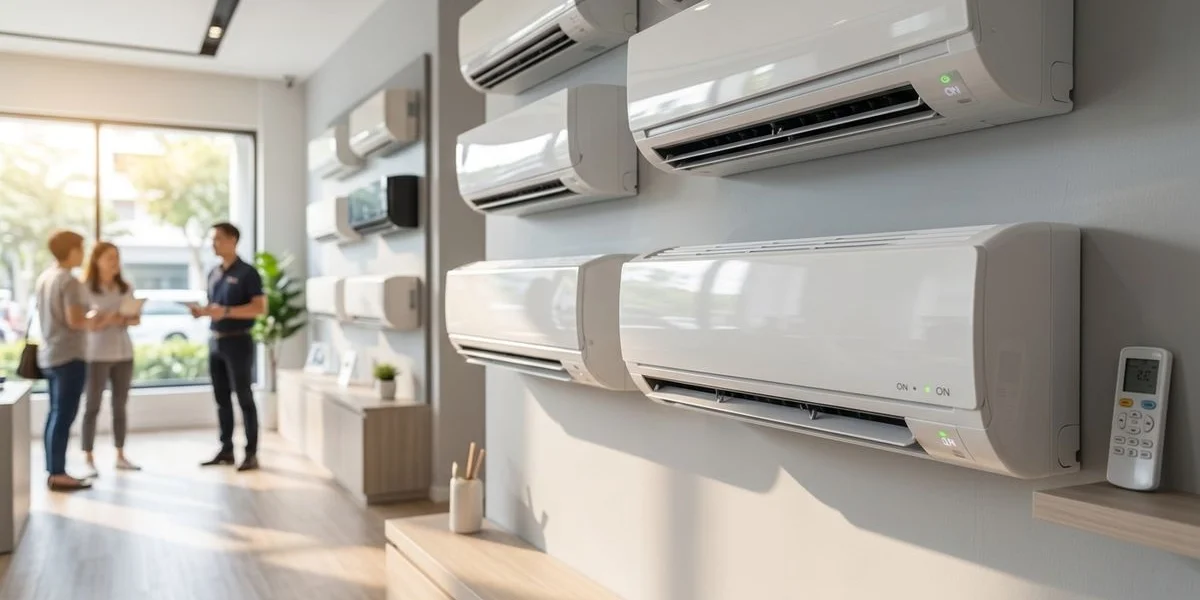
Daikin and Mitsubishi Starmex dominate the Singapore residential cooling market, holding roughly 60% of the total market share. Choosing the right system depends entirely on your specific cooling priorities, from raw efficiency to silent operation.
We see these two Japanese giants going head-to-head in thousands of homes every year at Coolbest Aircon Servicing.
Both manufacturers provide excellent reliability and support over 100 authorised service partners across the island. The minor technical differences between their latest 2026 models carry significant weight for your daily comfort and utility bills.
Brand Snapshot
The fundamental difference lies in their current flagship technologies for Singapore. Daikin pushes smart home integration with their iSmileEco series, while Mitsubishi Electric focuses on ultra-quiet operation and internal cleanliness with the Starmex FP series.
| Feature | Daikin | Mitsubishi Electric (Starmex) |
|---|---|---|
| Founded | 1924, Osaka | 1921, Tokyo |
| Singapore presence | Direct subsidiary and dealer network | Direct subsidiary and dealer network |
| Range in Singapore | iSmileEco, FTKA, MX series, VRV | Starmex FP/GP, SMSX, Mr Slim |
| Flagship residential | iSmileEco 5-tick inverter | Starmex FP 5-tick inverter |
Our installation teams handle the complete range of products from both manufacturers, ranging from basic single-splits for HDB bedrooms to complex commercial VRV layouts. The Daikin parts centre in Ang Mo Kio ensures almost zero downtime for local repairs.
We find that homeowner brand loyalty usually dictates the final choice, but looking at the hard data reveals clear winners for specific room types. Both brands continue to set the industry standard for reliable performance.
Efficiency (NEA Energy Tick)
At the 9,000 BTU and 12,000 BTU sizes commonly used in HDB bedrooms, both brands perform exceptionally well. Both the Daikin iSmileEco series and the Mitsubishi Starmex FP series achieve the maximum 5-tick rating from the National Environment Agency for 2026.
To understand their real-world performance, look at the Cooling Seasonal Performance Factor (CSPF) at the standard 9,000 BTU size.
- Daikin iSmileEco (9,000 BTU): 5 ticks, CSPF around 5.8
- Mitsubishi Starmex FP (9,000 BTU): 5 ticks, CSPF around 5.9
- Daikin iSmileEco (12,000 BTU): 5 ticks, CSPF around 5.7
- Mitsubishi Starmex FP (12,000 BTU): 5 ticks, CSPF around 5.9
Our utility tracking shows that a 5-tick system reduces electricity costs significantly compared to older 3-tick models. Mitsubishi maintains its high efficiency longer due to a proprietary Dual Barrier Coating applied to the internal components. This coating actively prevents dust and grease from sticking to the fan and heat exchanger.
We recommend Mitsubishi for households that run their air conditioning for more than eight hours a night, as that coating retains up to 18% better efficiency over the unit’s lifespan. Daikin counters this with excellent eco-friendly R32 refrigerant systems that boast a low Global Warming Potential of 675. Both units deliver an excellent cooling experience.
Noise At Low Fan
Mitsubishi Starmex is the objective winner for ultra-quiet bedroom operation. Sound levels matter immensely in compact HDB and condo bedrooms where the indoor unit sits just a few metres from your bed.
| Model (9,000 BTU) | Indoor Noise (dBA) | Feature Note |
|---|---|---|
| Daikin iSmileEco CTKM25 | 19 dB | Intelligent Eye sensor |
| Mitsubishi Starmex FP10 | 19 dB | E-Filter Noise-Reduction |
| Daikin Standard Inverter | 21 dB | Standard airflow |
| Mitsubishi Starmex GP | 22 dB | High-power mode |
Both flagship models technically achieve a whisper-quiet 19 decibels at their lowest fan setting. The perceived sound quality differs slightly in practice.
We constantly hear feedback from light sleepers praising the Mitsubishi Starmex for having less mechanical vibration. Daikin’s iSmileEco is equally quiet on paper but focuses heavily on smart features like the Intelligent Eye, which directs airflow away from human occupants to prevent cold drafts. For an absolutely silent bedroom, Mitsubishi remains the top recommendation.
Warranty
Warranty coverage from both manufacturers is identical on paper, offering comprehensive protection for standard residential installations in Singapore. Warranty administration speed is the true differentiator here.
The standard coverage for both brands includes the following terms.
- Daikin standard: 1-year comprehensive coverage for parts and labour, plus 5-year protection for the compressor.
- Mitsubishi Starmex standard: 1-year comprehensive coverage for parts and labour, plus 5-year protection for the compressor.
- Extended warranty options: Both brands offer paid extensions up to 10 years on the compressor through authorized dealers.
Our administrative staff process claims for both brands daily. The Mitsubishi Starmex dealer portal consistently provides smoother processing, resulting in claim turnarounds that are one to two weeks faster on average. Daikin requires slightly more paperwork for part replacements but honors their commitments just as reliably.
We always advise homeowners to register their digital warranties immediately after installation to avoid any delays during a breakdown. A registered warranty guarantees prompt attention from the manufacturer’s local support team.
Parts Availability In Singapore
Daikin wins the local supply chain battle easily. Securing replacement parts quickly prevents you from sweating through a hot Singapore night.
For common wear-and-tear components like printed circuit boards (PCBs), fan motors, and thermistors, the turnaround times vary slightly.
- Daikin: Most parts sit ready at local dealers or their massive Tampines and Ang Mo Kio hubs, taking 0 to 2 days for retrieval.
- Mitsubishi Starmex: Standard parts take 1 to 3 days, while complex components for commercial systems might require up to 5 days.
- Rare faults: Both brands might need to order from regional warehouses, taking 5 to 10 days.
Our repair technicians carry common spare parts for both brands in their vans. This strong local inventory means standard residential breakdowns rarely leave you waiting long. Daikin simply has a slight edge due to their massive local service infrastructure.
Price At Comparable BTU (9,000 BTU, 2026)
Daikin offers a slightly more accessible entry price for multi-split systems, while Mitsubishi commands a premium for its specialized filtration and quiet operation. Installation costs will vary based on the complexity of your piping and bracket requirements.
| Model Configuration | Average Price (SGD) | Ideal For |
|---|---|---|
| Daikin System 2 (iSmileEco) | $2,380 to $2,500 | 2 HDB Bedrooms |
| Mitsubishi System 2 (Starmex FP) | $2,550 to $2,700 | 2 HDB Bedrooms |
| Daikin System 3 (iSmileEco) | $3,350 to $3,500 | 3 HDB Bedrooms |
| Mitsubishi System 3 (Starmex FP) | $3,500 to $3,700 | 3 HDB Bedrooms |
We update these figures based on standard HDB installations requiring new piping and upgraded Armaflex insulation. Upgrading to thicker half-inch insulation and 22 SWG copper piping adds to the initial quote but prevents expensive water leaks later. Your final invoice will reflect these material upgrades, which are non-negotiable for longevity in a humid climate.
Service Network
You will never struggle to find a qualified technician for a Daikin or Mitsubishi unit in Singapore. Both brands support massive ecosystems of authorized service partners.
Over 100 independent companies carry official certifications to handle these units. This density ensures you can secure a same-day or next-day diagnostic visit almost anywhere on the island, from Jurong West to Pasir Ris.
We train our own staff extensively on the specific diagnostic codes for both the Daikin iSmileEco and Mitsubishi Starmex platforms. This universal familiarity means you are never locked into a single expensive service provider.
Use Case Recommendations
Matching the right unit to your specific living situation prevents buyer’s remorse. The differences in features dictate clear winners for different room types.
| Scenario | Our Recommendation | The Reason |
|---|---|---|
| HDB bedroom, tight budget | Daikin Standard Inverter | Excellent baseline cooling without premium feature costs. |
| Master bedroom, light sleeper | Mitsubishi Starmex FP | 19 dB operation and zero plastic vibration sounds. |
| Smart home integration | Daikin iSmileEco | Built-in Wi-Fi and seamless D’SmartHome upgrade path. |
| Landed property, 4+ rooms | Mitsubishi Starmex Multi | Superior energy balancing across multiple heavy-load zones. |
| Condo living room | Daikin iSmileEco | Slimmer indoor profile and Coanda airflow for wide coverage. |
We constantly see homeowners matching brands to specific needs. A tech-savvy homeowner controlling appliances via smartphone will love Daikin’s mobile app. A family with young children will benefit immensely from Mitsubishi’s easy-to-clean design, which allows you to unclip the louvres and wipe the internal fan directly.
The Honest Summary
Neither brand will disappoint you at current 2026 market standards. Your decision comes down to a few distinct tiebreakers.
- Pick Daikin if: You want smart home connectivity, a slightly lower initial purchase price for System 3 setups, and the absolute fastest parts replacement in Singapore.
- Pick Mitsubishi Starmex if: You prioritize a completely silent bedroom, demand the easiest DIY cleaning process, and want maximum long-term efficiency via their Dual Barrier Coating.
Our install data shows identical satisfaction rates for both choices. Choose the features that align with your daily habits.
Don’t Pick These Alternatives Unless You Know Why
While Daikin and Mitsubishi lead the pack, several other brands occupy specific niches in the market. You must understand their compromises before selecting them to save money.
- Panasonic (X-Series): A fantastic choice if indoor air quality is your primary concern. Their 2026 nanoe-X technology neutralizes airborne pollutants effectively, but the units command a premium price similar to Mitsubishi.
- Midea (All Easy Pro): The undisputed king of budget installations. A System 3 can cost roughly $700 less than a Starmex, but you sacrifice premium build quality and ultra-quiet operation.
- LG (Artcool): Offers beautiful, mirror-finish designs and aggressive pricing. The spare parts network is simply thinner than the Japanese giants, leading to longer repair delays.
- Samsung (WindFree): Features innovative draft-free cooling technology. The service density cannot match Daikin, making routine maintenance slightly harder to schedule.
We repair all these brands regularly. A budget brand works perfectly for a guest room used twice a month, but a heavily utilized master bedroom demands the reliability of a tier-one Japanese manufacturer.
Book An Install
We install both Daikin and Mitsubishi Starmex with authorised warranty activation.
Visit our Aircon installation service page or WhatsApp +65 9182 5233 for a per-room quote.