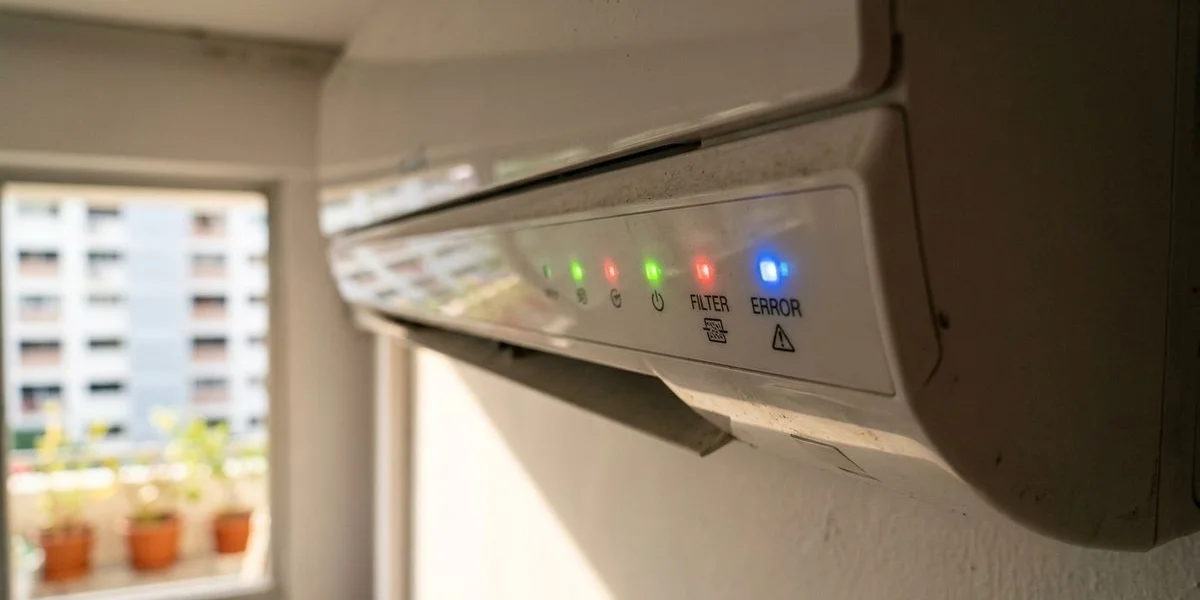
Finding a reliable Aircon Blinking Lights Error Code Guide (All Brands) is the first step when your cooling system suddenly stops working. We know that decoding these flashes can save you hundreds of dollars in unnecessary diagnostic fees. Counting the blinks accurately allows you to pinpoint the root cause before a professional arrives.
Our technicians at Coolbest Aircon Servicing handle these exact troubleshooting calls across Singapore every single day.
You can sometimes even clear the error yourself with a simple system reset. We have compiled this updated 2026 resource to help you quickly identify the most common air conditioning faults.
How To Read Blink Patterns
Identifying the exact fault code requires careful observation of your indoor unit’s display panel. We always advise customers to record a short video of the flashing lights on their smartphone. This simple step prevents you from miscounting the sequence or forgetting the exact pattern. Our team uses these specific sequences to prepare the correct spare parts before we even leave our workshop.
- Power off completely: Switch off the air conditioning unit at the remote and wait exactly 30 seconds.
- Restart and observe: Turn the system back on and watch carefully to see which specific LED starts blinking, such as the Timer, Run, or Filter light.
- Count the sequences: Tally the total number of blinks while paying close attention to any long pauses between the flashes.
- Document the colour: Note whether the light is green, red, or orange, as manufacturers often use different colours to categorise specific system faults.
Pattern notation usually follows a distinct sequence to indicate a two-digit code. We interpret “three slow green blinks, a pause, and two slow green blinks” as either a 3.2 or an E32 error, depending on your exact model.
First Try: The 5-Minute Reset
System glitches caused by minor power fluctuations can sometimes trigger a false error code. We frequently encounter situations where a simple system reboot resolves the blinking light issue entirely. Before attempting to decode the specific pattern, you must try a hard reset to discharge the internal capacitors. Our recommended 2026 protocol involves completely cutting the power supply rather than just using the remote control.
- Switch off the unit directly at the wall switch or main circuit breaker.
- Wait a full five minutes to allow the system capacitors time to safely discharge.
- Turn the wall switch back to the on position.
- Wait 30 seconds before testing the cooling performance.
Cooling will resume normally if the blinking stops after this procedure. We suggest moving on to the specific brand decoder below if the error returns within an hour. Continuous resetting can permanently damage the printed circuit board. We strongly advise against repeated reset attempts to avoid inflating your repair bill.
Daikin Common Codes
Daikin air conditioners typically display their specific diagnostic alphanumeric code directly on the indoor unit’s digital panel. We also frequently read these codes by observing the blink counts on Daikin cassette or ducted systems. Singaporean homeowners face Daikin A1 and U4 errors most frequently due to our high ambient humidity levels. Our technicians note that a Daikin Printed Circuit Board replacement for an A1 error typically costs between S$80 and S$350 in 2026.
| Display Code | Likely Cause | DIY Or Pro |
|---|---|---|
| A1 | Printed Circuit Board (PCB) fault on the indoor unit | Pro (Requires PCB replacement) |
| A3 | Drainage water level sensor tripped | Pro (Often a blocked drainage pipe) |
| A5 | High pressure detected in the cooling cycle | Pro |
| C4 | Heat exchanger thermistor component fault | Pro |
| E7 | Outdoor fan motor locked | Pro (Check the outdoor condenser for physical blockages) |
| U0 | Low refrigerant pressure or a gas leak | Pro (Requires a pressure leak check and R32/R410A top-up) |
| U4 | Indoor to outdoor unit communication error | Pro (Usually faulty wiring or a blown PCB) |
A U0 code generally means the system lacks sufficient R32 or R410A refrigerant gas to cool the room. We perform a comprehensive pressure test before adding any new gas, as topping up without fixing the leak guarantees a repeat failure. The standard market rate for a professional refrigerant top-up currently ranges from S$80 to S$150.
Mitsubishi Starmex Common Codes
We highly recommend checking both the Operation LED and the Timer LED on your Mitsubishi Starmex unit. This brand utilises a combination of these two lights to pinpoint exact hardware failures. Our repair records show that Starmex indoor coil sensor faults are among the most common issues in Singaporean HDB flats. You can identify this specific sensor failure when the Timer LED blinks exactly five times before pausing and repeating.
| Operation LED | Timer LED | Likely Cause & Details |
|---|---|---|
| Off | 2 blinks | Room temperature sensor fault |
| Off | 5 blinks | Indoor coil sensor fault (Typical S$80 to S$120 replacement) |
| Off | 6 blinks | Outdoor coil sensor fault |
| 2 blinks | 1 blink | Indoor fan motor failure |
| 5 blinks | On | Compressor fault or inverter PCB failure (Costs S$300 to S$380) |
| 11 blinks | On | Refrigerant gas leak or major system error |
We want to highlight that five blinks on the Operation LED points to a much more serious outdoor condenser or inverter PCB problem. Premium replacement parts for a Mitsubishi compressor fault can cost upwards of S$380 out of warranty. Our standard procedure involves thoroughly testing the condenser’s inverter board before recommending a complete unit replacement. Regular chemical servicing extends the lifespan of these sensitive outdoor components significantly.
Panasonic Econavi Common Codes
Panasonic Econavi models rely almost entirely on the Timer LED to broadcast their diagnostic alerts. We frequently encounter the dreaded H11 error code on these systems during heavy usage months. This specific single-blink pattern indicates an abnormal communication failure between the indoor blower and the outdoor condenser. Our technicians usually discover that this failure stems from either a severed connecting wire or a shorted Insulated Gate Bipolar Transistor (IGBT) on the outdoor circuit board.
| Blink Pattern | Diagnostic Code | Meaning & Potential Action |
|---|---|---|
| 1 blink | H11 | Indoor and outdoor unit communication failure |
| 2 blinks | H19 | Indoor fan motor stall or malfunction |
| 3 blinks | H23 | Indoor coil temperature sensor error |
| 4 blinks | H27 | Outdoor coil sensor abnormality |
| 5 blinks | H28 | Outdoor pipe temperature sensor fault |
| 11 blinks | F90 | Power factor correction circuit defect |
Panasonic systems stuck on a blinking pattern for more than 10 minutes after a wall-switch reset require immediate professional intervention. We strongly advise against running the unit when it displays an F90 or H11 code to prevent a total motherboard burnout. Replacing a damaged outdoor PCB on an Econavi unit typically costs between S$200 and S$400 in Singapore.
Toshiba Common Codes
We notice that Toshiba diagnostic patterns can vary significantly depending on the specific manufacturing series. Modern units utilise a combination of the Operation, Timer, and Standby lights to communicate internal faults. Our most requested Toshiba repair involves fixing an indoor temperature sensor failure. You will see the Timer light emitting five slow flashes when this particular sensor degrades.
- Operation and Timer flashing simultaneously: This combination highlights a complete communication breakdown between the indoor fan coil and the outdoor condenser.
- Timer light emitting 5 slow blinks: This pattern confirms a faulty indoor temperature sensor that requires a quick replacement.
- Timer and Standby lights flashing together: This sequence indicates an abnormal compressor electrical current, which often signals an impending motor failure.
We always inspect the outdoor compressor wiring first when encountering the combined Timer and Standby warning. Ignoring an abnormal compressor current warning can lead to a catastrophic motor failure that costs over S$500 to rectify.
LG Common Codes
LG air conditioning units often bypass the blinking light system entirely by displaying an exact alphanumeric code directly on the LCD panel. We find this direct display method incredibly helpful for diagnosing faults quickly over the phone. The CH05 communication error remains the most prevalent issue for older LG systems installed in local condominiums. Our inventory always includes replacement Brushless DC (BLDC) motors to resolve the common CH10 indoor fan faults on the spot.
| LG LCD Code | Technical Fault Description |
|---|---|
| CH 05 | Communication breakdown between indoor and outdoor units |
| CH 06 | Outdoor fan DC motor error or failure |
| CH 10 | Indoor fan Brushless DC (BLDC) motor malfunction |
| CH 21 | DC compressor Intelligent Power Module (IPM) fault |
| CH 22 | Compressor electrical over-current detected |
An Intelligent Power Module (IPM) fault triggering a CH21 code usually requires a costly replacement of the inverter board. We highly recommend checking your LG warranty status before proceeding, as premium parts can be expensive.
When The Code Means “Serious”
We classify certain diagnostic alerts as critical hardware failures that a simple power reboot will never resolve. These specific codes indicate severe component degradation that demands immediate professional replacement parts. Our transparent pricing model ensures you know exactly what these major repairs entail before work begins. Attempting to run an air conditioner with a known severe fault will likely destroy the remaining healthy components.
- Compressor failures: Any code referencing the compressor, such as the E6, CH21, or F5x series, signals a major breakdown that can cost between S$300 and S$800 to fix.
- Circuit board malfunctions: PCB fault codes across all brands dictate an immediate electronic board replacement, as these brains of the operation cannot be patched locally.
- Gas leak indicators: Refrigerant leak warnings require a thorough pressure test, a professional leak seal, and a complete gas top-up to restore cooling efficiency.
- Blower motor stalls: Fan motor error codes usually mean the internal bearings have seized, requiring a full motor replacement priced between S$200 and S$350.
We use specialised diagnostic tools to confirm whether a compressor is truly dead or just suffering from a blown starting capacitor. A S$50 capacitor replacement is a much better outcome than a S$800 compressor overhaul.
What To Do With The Code
Gathering the correct information before contacting a technician drastically reduces your overall repair timeline. We have structured our booking process to eliminate unnecessary multiple visits to your home. Providing clear details upfront allows the dispatch team to load the exact required spare parts into their service vans. Our streamlined approach means your cooling system gets fixed in a single appointment.
- Capture the evidence: Take a clear photograph or record a short five-second video of the exact blinking light pattern.
- Locate the model number: Find the manufacturer’s sticker on the side or bottom panel of your indoor unit and write down the exact model series.
- Send the details: Forward both the video and the model number to your service provider for an accurate preliminary diagnosis.
This preparation ensures the technician arrives fully equipped to resolve your specific error code immediately. We encourage you to securely Book a repair diagnosis online once you have your details ready.
Codes That Sometimes Resolve On Reset
We want to reassure you that not every blinking light signifies a catastrophic hardware failure. Certain temporary environmental factors can trigger the internal sensors to throw a cautionary error code. Our customer support team successfully resolves about twenty percent of daily technical queries simply by walking homeowners through a proper five-minute wall-switch reset. You should always try this step first if you encounter any of the specific faults listed below.
- Signal misfires: Communication errors like the Daikin U4, Panasonic H11, or LG CH05 can occasionally stem from a momentary signal drop rather than a broken wire.
- Minor blockages: Water level sensor trips, such as the Daikin A3 code, sometimes clear up if a minor drainage clog naturally washes away.
- Electrical surges: Sensor drift codes frequently appear right after a heavy Singapore thunderstorm causes a sudden electrical power dip in your neighbourhood.
We must emphasise that an error code returning after a successful reset points to a genuine mechanical fault. Continuously forcing a system to restart against its own safety protocols will inevitably cause permanent damage to the expensive circuit boards.
WhatsApp The Pattern
Getting a fast and accurate quote for your specific air conditioner fault is incredibly straightforward.
We invite you to send a short five-second video of your blinking lights along with your unit’s model number directly to our WhatsApp support line. Providing this visual evidence allows the technical team to decode the exact issue and prepare a transparent repair estimate before anyone travels to your location.
Our policy waives the standard S$40 to S$60 diagnostic fee entirely if you choose to proceed with the recommended repair work. Book an aircon repair visit with the Coolbest Aircon Servicing team today to restore your home’s comfort quickly and affordably.